

Google Ecosystem · Book 04
Merchant Center and Product Data
Product data is the public record of the price, stock, image and delivery promise customers see. Not just a visible product: a verifiable offer.
By the end of the book
- Audit displayed prices, images, availability and delivery promises against the actual purchase.
- Diagnose price-stock discrepancies across website, source, structured data and checkout.
- Manage free listings, local inventory and policy processes with evidence.
Book files are in Turkish.
Written by Onur Dilmen · Edition 1.0 · · 16 chapters, 20 appendices · 124 pages
TRY 790VAT included · one-time payment
Read the sample chapter (free)- Available in your panel after payment confirmation, with ongoing access.
- Print PDF, mobile PDF, Word and EPUB.
- New editions are free.
Digital content is delivered immediately; you separately confirm the withdrawal conditions at checkout.
Bu kitap hangi sorulara cevap veriyor?
Each chapter opens with a question and ends with its answer. 16 chapters ve 20 ek.
- 01
How do identity, price and availability stay consistent across store, product data and Google?
Chapter 1 · Where is the product catalog's source of truth?
- 02
Does Merchant Center represent the actual seller and correct domain, with clear ownership and verification?
Chapter 2 · Account, store, ownership and website verification
- 03
How large and changeable is the catalog, which system is authoritative, and who may fix errors?
Chapter 3 · Product Sources: Manual, File, Platform or API?
- 04
Does every row unambiguously identify the exact product variant sold to the customer?
Chapter 4 · Product identity, variants, GTIN, brand and category
- 05
Which product did the customer click, and which can they actually buy?
Chapter 5 · Title, description, image and landing-page quality
- 06
Do customer-visible and Google-read prices and stock agree, and where and when does a discrepancy arise?
Chapter 6 · Price, Discounts, Availability and Update Delays
- 07
Do Merchant Center shipping and returns match website and checkout promises?
Chapter 7 · Shipping, Delivery and Returns: Match the Store Promise
- 08
Does product markup describe the same product, price and stock as the visible and submitted offer?
Chapter 8 · Structured data and product-page/feed consistency
- 09
Why are my eligible free listings not shown in every search?
Chapter 9 · Free Listings: Eligibility Versus Impressions
- 10
At which layer does the product-visibility problem start?
Chapter 10 · Diagnostics: Data Errors, Product Rejection and Account Issues
- 11
Which catalog information creates misrepresentation risks?
Chapter 11 · Misrepresentation and Policy Risks: From Catalog to Store
- 12
When and with which evidence should re-review be requested?
Chapter 12 · Corrections, Re-Review and Appeal Evidence
- 13
Does eligibility in one country apply to every country and branch?
Chapter 13 · Countries, Stores and Local Inventory Require Separate Decisions
- 14
How is a product managed from launch to removal?
Chapter 14 · Product Lifecycle: New, Changed, Sold Out and Removed
- 15
Which indicators and review intervals track catalog quality?
Chapter 15 · Catalog Quality Indicators and Operating Rhythm
- 16
Is this catalog ready for paid traffic?
Chapter 16 · Ads Readiness Gate: Do Not Launch Before Data Is Ready
20 appendix headings
- AProduct Data Contract: Fields, Sources, Owners and Acceptance
- BPrice-Stock Reconciliation: Make Timing Visible
- CIssue Triage Cards: Which Team and First Test?
- DFull Case: Why Does a Campaign Price Differ Everywhere?
- ESource and Version Log
- FMerchant Center Terms That Must Not Be Confused
- GLocal Inventory Workshop Across 48 Stores
- HVariant and GTIN Repair: 240 Incorrect Rows
- IShipping and Returns: Three Carts, Three Decisions
- JMisrepresentation Review File: Evidence Before Defense
- KThree-Country Offers: Language, Currency and Delivery
- LCatalog Migration: Preserve Offer Identity When SKUs Change
- MStructured Data Error Laboratory
- NFree Listing Reports: Separate Approval, Impressions and Sales
- OFeed/API Incident Desk: Missing Files, Old Products and Duplicate Sources
- PAds Readiness Board: Is an Uploaded Catalog Enough?
- QPackages, Bundles and Unit Prices: What Does the Customer Buy?
- RAI Product Content: Evidence and Labels Before Speed
- SCampaign Incident Rehearsal: Reliable Signals Within 90 Minutes
- TUsed and Refurbished Products: Translate Condition into an Offer
Inside the book
Pages from the sample chapter. Businesses and figures in the examples are synthetic.
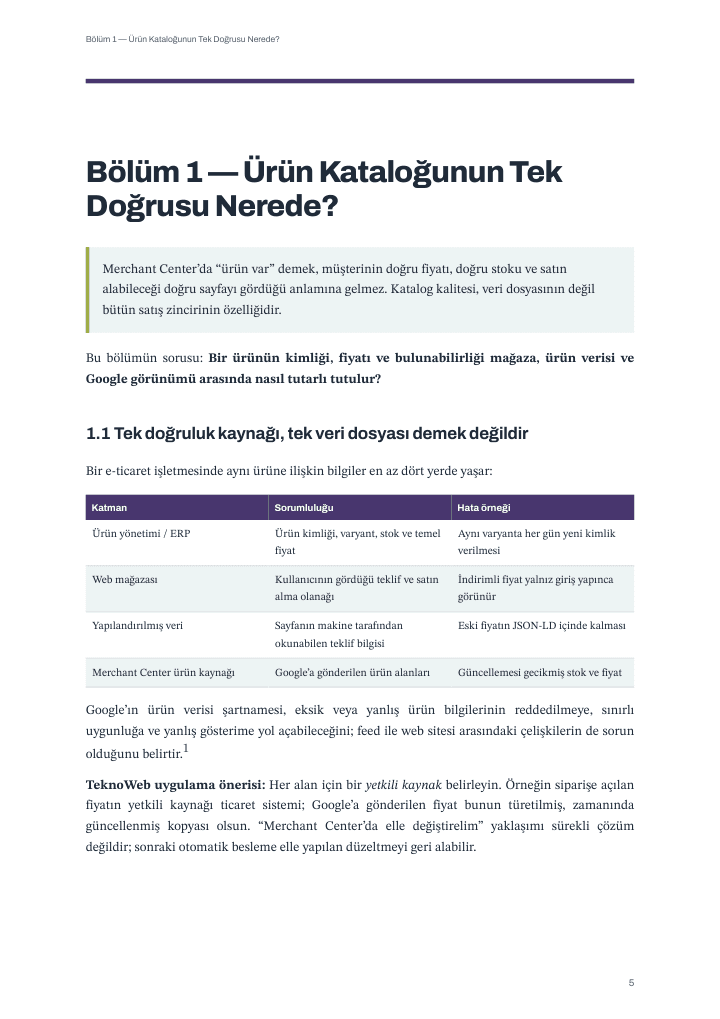
Chapter 1 opening and guiding question (Turkish edition) 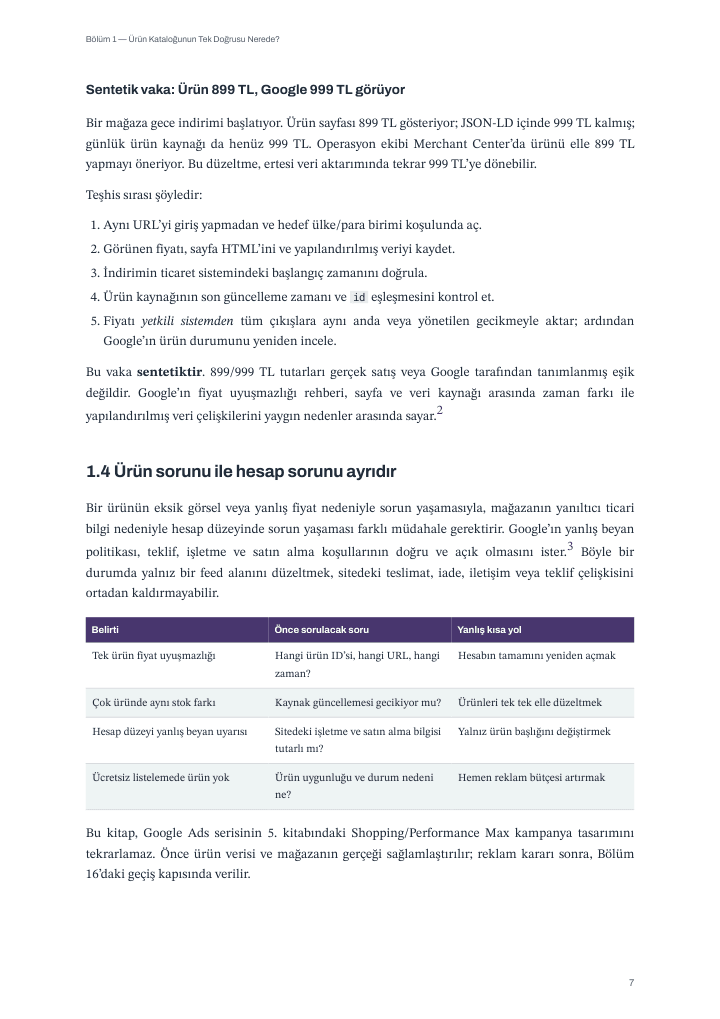
Synthetic case: TRY 899 versus TRY 999 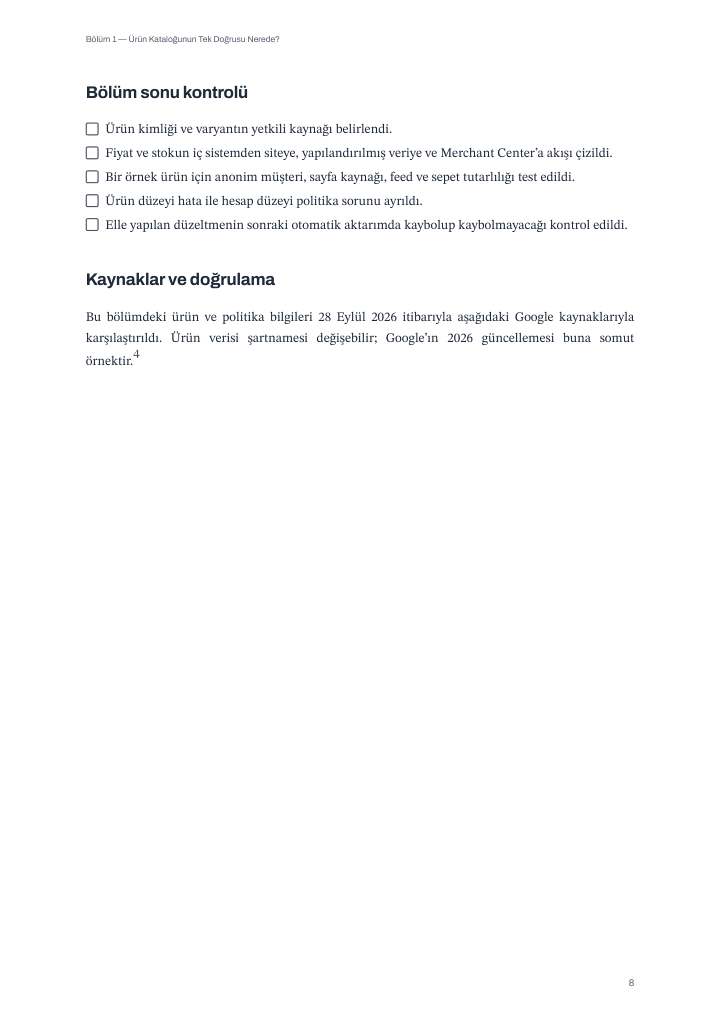
Chapter checklist
Who it is for
- Businesses selling products on their own websites
- Catalog managers
- Agency specialists
- Technical integration teams
Who it is not for
- People seeking Shopping/PMax campaign strategy (Google Ads Book 5)
- People expecting guaranteed sales or impressions
 Related bookShopping and Performance MaxCovers Shopping and Performance Max campaign design that this book does not repeat.
Frequently asked questions
- Does it teach Shopping or Performance Max campaign setup?
- No. That belongs to Google Ads Book 5. This book covers catalog accuracy, free listings and Merchant Center operations. Establish correct product and store data before the chapter 16 advertising-readiness gate.
- Does it guarantee my products will appear on Google?
- No. Neither free nor paid visibility is guaranteed, and this is not an official Google certification. Recheck official policy, country and field requirements before implementation.
- Who is this book for?
- Online sellers, catalog managers, agencies and integration teams. Chapters provide decision and root-cause frameworks; appendices provide files, cases, negative tests and acceptance forms.
- When can I access the book after payment?
- Immediately after payment approval. Files appear in your Academy library and an access email is sent.
- What happens when a book is updated?
- The book is revised when Google interfaces or regulations change. New editions appear in your library at no extra cost.
- Can I get a refund?
- Digital delivery follows payment approval, with a withdrawal-right exception under distance-selling rules. Read the free sample chapter before purchase.
- Is an invoice issued?
- Yes. Enter personal or business billing details when ordering to receive an e-archive invoice.
Author

Author and trainer
Onur Dilmen
TeknoWeb founder. He has built business infrastructure in hosting and platforms for years, observing recurring advertising-account, measurement and search-visibility mistakes and their actual invoiced cost. The Academy series record those observations.
- Technical claims reference dated official Google sources
Its place in the series
TeknoWeb Akademi is an independent educational publisher, unaffiliated with and unendorsed by Google, Meta, Microsoft, TikTok or LinkedIn. Google and Google Ads are Google LLC trademarks; other marks belong to their owners.