

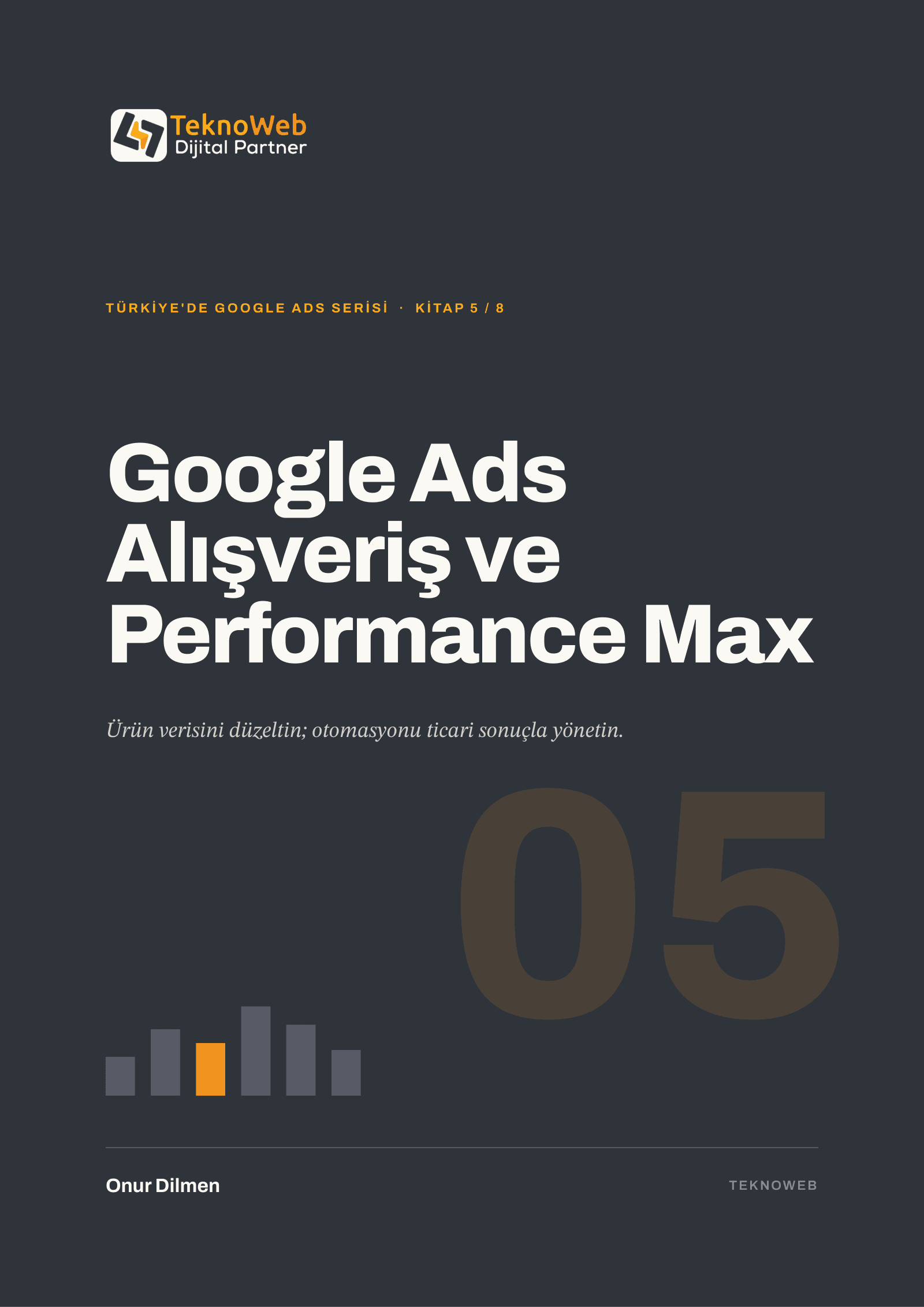
Google Ads in Türkiye series · Book 05
Google Ads: Shopping and Performance Max
Getting a product into an ad and selling it profitably are different achievements. Fix product data; guide automation by business results.
By the end of the book
- Audit Merchant Center product, price, availability and delivery data against the promise made to customers.
- Define the data to verify, automation limits and how to interpret results.
- Decide which products to test in which campaigns, with defined profit limits, measurement and controls.
Book files are in Turkish.
Written by Onur Dilmen · Edition 1.0.1 · · 15 chapters, 6 appendices · 58 pages
TRY 790VAT included · one-time payment
Read the sample chapter (free)- Available in your panel after payment confirmation, with ongoing access.
- Print PDF, mobile PDF, Word and EPUB.
- New editions are free.
Digital content is delivered immediately; you separately confirm the withdrawal conditions at checkout.
Bu kitap hangi sorulara cevap veriyor?
Each chapter opens with a question and ends with its answer. 15 chapters ve 6 ek.
- 01
Who owns the store domain, Merchant Center and Google Ads account?
Chapter 1 · Merchant Center Foundations
- 02
Which purchasable store product does each catalog row represent?
Chapter 2 · Product Data: From Identity to Imagery
- 03
At what final total and delivery terms can a product displayed at ₺1,999 in Türkiye actually be purchased?
Chapter 3 · Sales Terms in Türkiye: Price, Shipping and Returns
- 04
If a product is missing, is the problem in the account, product, source, website or campaign?
Chapter 4 · Product Diagnostics and Correction Order
- 05
When is Standard Shopping a better starting point than PMax?
Chapter 5 · Controlled Learning with Standard Shopping
- 06
Which products can cover their advertising costs?
Chapter 6 · Product Economics and Bidding Decisions
- 07
Which products, objectives and creative scope should launch with PMax?
Chapter 7 · Performance Max Architecture
- 08
Which products can share a message and landing page?
Chapter 8 · Asset Groups and Creative Quality
- 09
How much customer information can we safely provide to PMax?
Chapter 9 · Audience Signals and Search Themes
- 10
Which search or page behaviors need limits, and why?
Chapter 10 · Brand, Negative Keyword and URL Controls
- 11
Which decisions can each data source support?
Chapter 11 · PMax Reporting and Its Blind Spots
- 12
Can PMax be tested without stopping Standard Shopping?
Chapter 12 · Standard Shopping and PMax: Coexistence and Experiments
- 13
When do objectives beyond online purchases need a separate architecture?
Chapter 13 · Local Inventory, Store and Travel Objectives
- 14
Should AI Max for Shopping be enabled?
Chapter 14 · AI Max for Shopping: Beta Eligibility Gate
- 15
How does a campaign stay safe when the platform, data source or product conditions change?
Chapter 15 · Unknowns and Operational Rollback
6 appendix headings
- AShopping and PMax Checklist
- BData and Decision Templates
- CSynthetic Account Examples
- DGlossary
- EEvidence and Update Protocol
- FBibliography
Inside the book
Pages from the sample chapter. Businesses and figures in the examples are synthetic.
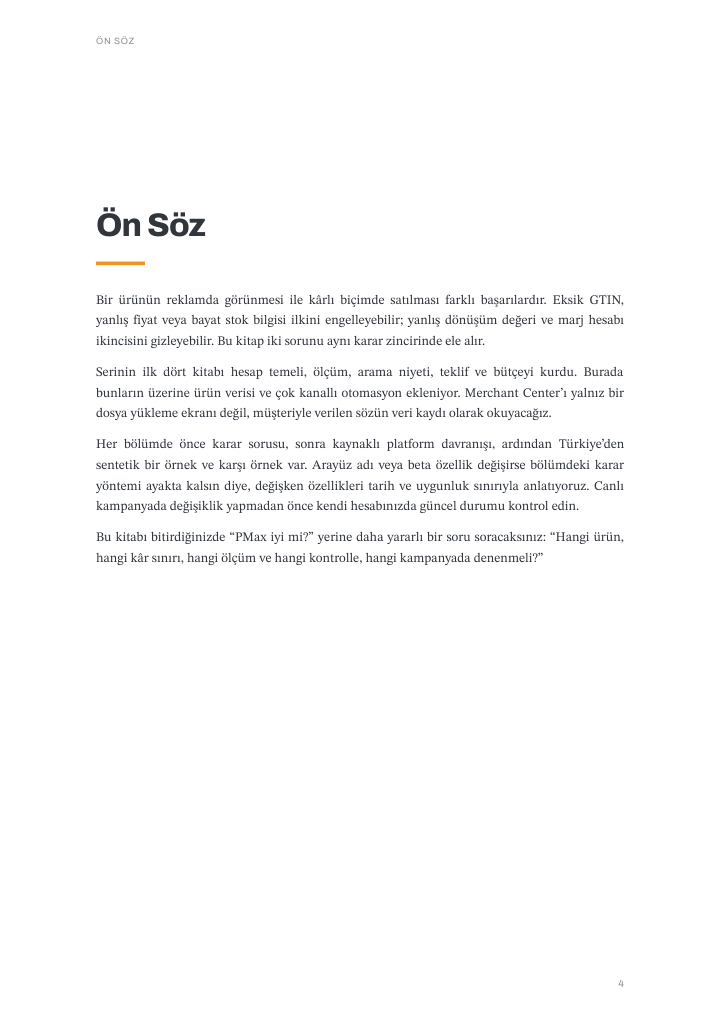
Preface 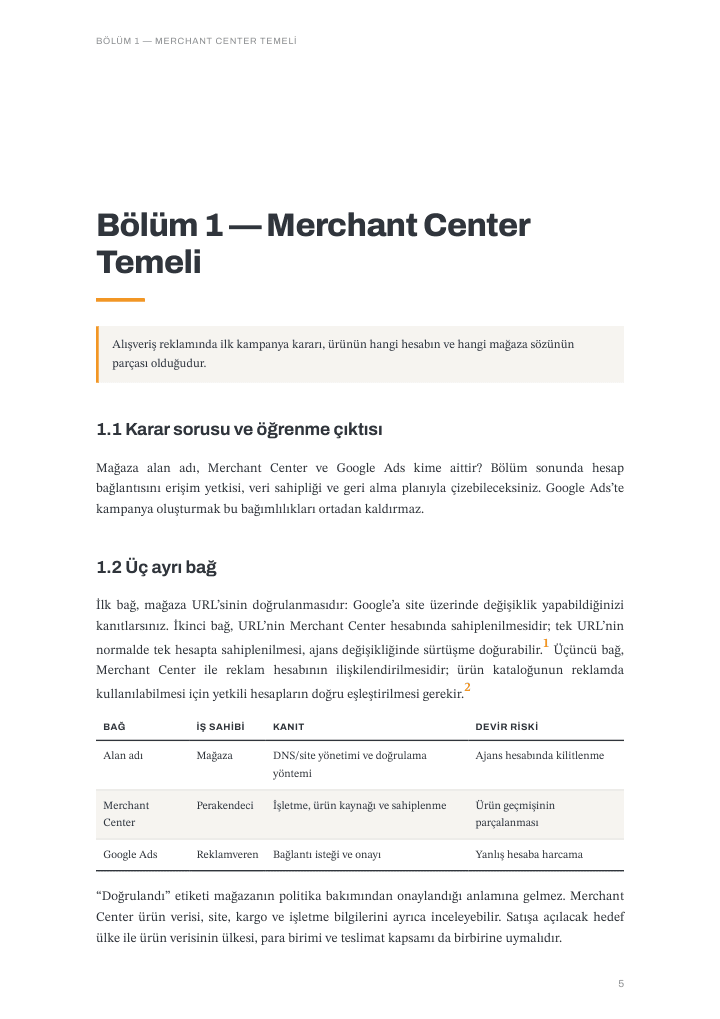
Chapter opening and decision question 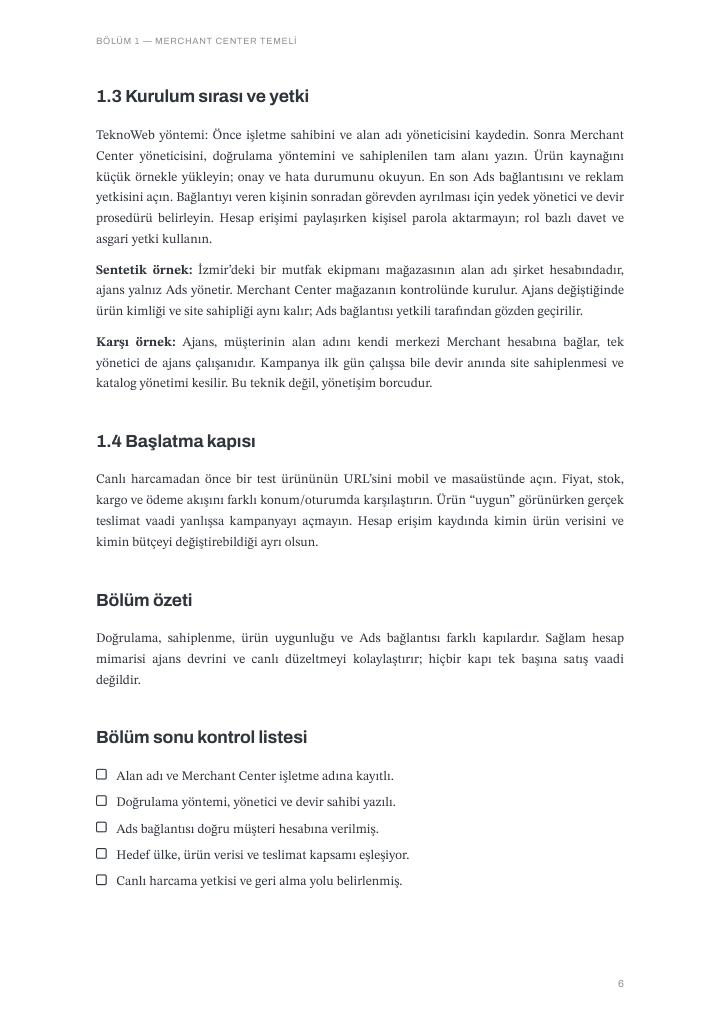
Synthetic example and chapter checklist
Who it is for
- E-commerce teams managing product ads
- People responsible for Merchant Center and product data
- Advertising specialists choosing between Standard Shopping and Performance Max
Who it is not for
- People expecting automation to work without correcting product data
- People seeking guaranteed sales, impressions or profit
 Related bookMerchant Center and Product DataCovers product data accuracy and Merchant Center operations; Shopping and Performance Max campaign design belongs to this book.
Frequently asked questions
- Does the book cover Merchant Center too?
- Yes. It connects product data with multi-channel automation and treats Merchant Center as a record of customer promises, rather than just a file-upload screen.
- Does the book remain useful when Google interfaces or beta features change?
- Variable features are dated and bounded by eligibility so the decision method remains useful. Verify the current state in your own account before changing live campaigns.
- Are the store examples and amounts real?
- No. Stores, amounts and performance data are synthetic. The book is educational and does not provide financial, tax or legal advice.
- When can I access the book after payment?
- Immediately after payment approval. Files appear in your Academy library and an access email is sent.
- What happens when a book is updated?
- The book is revised when Google interfaces or regulations change. New editions appear in your library at no extra cost.
- Can I get a refund?
- Digital delivery follows payment approval, with a withdrawal-right exception under distance-selling rules. Read the free sample chapter before purchase.
- Is an invoice issued?
- Yes. Enter personal or business billing details when ordering to receive an e-archive invoice.
Author

Author and trainer
Onur Dilmen
TeknoWeb founder. He has built business infrastructure in hosting and platforms for years, observing recurring advertising-account, measurement and search-visibility mistakes and their actual invoiced cost. The Academy series record those observations.
- Her teknik iddia Google dokümantasyonundan doğrulandı ve tarihiyle dipnotlandı
Its place in the series
TeknoWeb Akademi is an independent educational publisher, unaffiliated with and unendorsed by Google, Meta, Microsoft, TikTok or LinkedIn. Google and Google Ads are Google LLC trademarks; other marks belong to their owners.