

Google Ecosystem · Book 02
Search Console and Practical SEO
Not every unindexed URL is an error, and not every indexed page provides user value. Do not assume visibility; prove it at URL and user level.
By the end of the book
- Diagnose search visibility at URL and template level.
- Separate discovery, crawling, indexing, canonical selection and quality into decision gates.
- Connect performance reports and traffic drops to an evidence-based workflow.
Book files are in Turkish.
Written by Onur Dilmen · Edition 1.0 · · 16 chapters, 11 appendices · 120 pages
TRY 790VAT included · one-time payment
Read the sample chapter (free)- Available in your panel after payment confirmation, with ongoing access.
- Print PDF, mobile PDF, Word and EPUB.
- New editions are free.
Digital content is delivered immediately; you separately confirm the withdrawal conditions at checkout.
What does each chapter cover?
Each chapter's subject, using its opening question or statement. 16 chapters ve 11 ek.
- 01
How do you separate technical access, indexing and demand when search results disappoint?
Chapter 1 · Discovery, indexing and visibility are different
- 02
Which site and URLs belong to the property, and who is its real owner?
Chapter 2 · Search Console Property, Verification and Access
- 03
How does Google find important URLs, and do their server responses permit crawling?
Chapter 3 · Crawling: Discovery, Sitemaps, Robots and Server Responses
- 04
Indexing Diagnostics: URL Inspection and Page Indexing
A “Not indexed” label alone does not establish a fault.
- 05
Which URL should represent a product available at five duplicate addresses?
Chapter 5 · Canonical URLs, duplicates and filter/facet pages
- 06
Redirects, deleted pages and migrations
A site migration is more than 301 redirects to a new domain.
- 07
Are main content and links visible in rendered HTML at the correct URL and HTTP response without login?
Chapter 7 · Crawlable Content on JavaScript Websites
- 08
Internal Links, Information Architecture and Important Pages
A page can be in a sitemap and open directly while remaining disconnected from the site.
- 09
Content Quality, Search Intent and Trust
A crawlable, indexed page can still fail to solve a reader's problem.
- 10
Why did Google change my title?
Chapter 10 · Titles, descriptions, image and video visibility
- 11
Which real page information meets the requirements of a Google feature?
Chapter 11 · Structured data: eligibility, validation and limits
- 12
Reading Core Web Vitals and User Experience Data
A PageSpeed score of 100 does not mean SEO is complete.
- 13
Reading Search Console Performance Correctly
Performance reports help diagnose search impressions, clicks and their query, page, country and device contexts.
- 14
Did Search Console clicks, GA4 organic sessions, conversions or revenue decrease?
Chapter 14 · Traffic-Loss Diagnostics: Measurement, Indexing, Demand and Changes
- 15
Workbooks for Commerce, Local Services and Publishers
The same Search Console screen can lead to different decisions in three businesses.
- 16
Manage SEO Changes with Hypotheses, Records and Rollback
The hardest part often comes after finding errors: establishing which change caused which result.
11 appendix headings
- AURL Diagnosis Form and Completed Example
- BTechnical SEO Audit Checklist
- COrganic-Traffic Loss Decision Tree and Incident Record
- DSynthetic Migration: 640 URLs and Broken Mappings
- ESource, Version and Platform Change Log
- FTerms That Must Not Be Confused
- GPerformance Workshop: What Segments Reveal When Totals Mislead
- HFacet URL Workshop: Turn Combinatorial Growth into Product Decisions
- IJavaScript Release Acceptance: Visible on Screen, Missing in HTML
- JMultilingual Website Workshop: Align Turkish and English
- KLarge-Site Crawl Budget: Problem or False Alarm?
Inside the book
Pages from the sample chapter. Businesses and figures in the examples are synthetic.
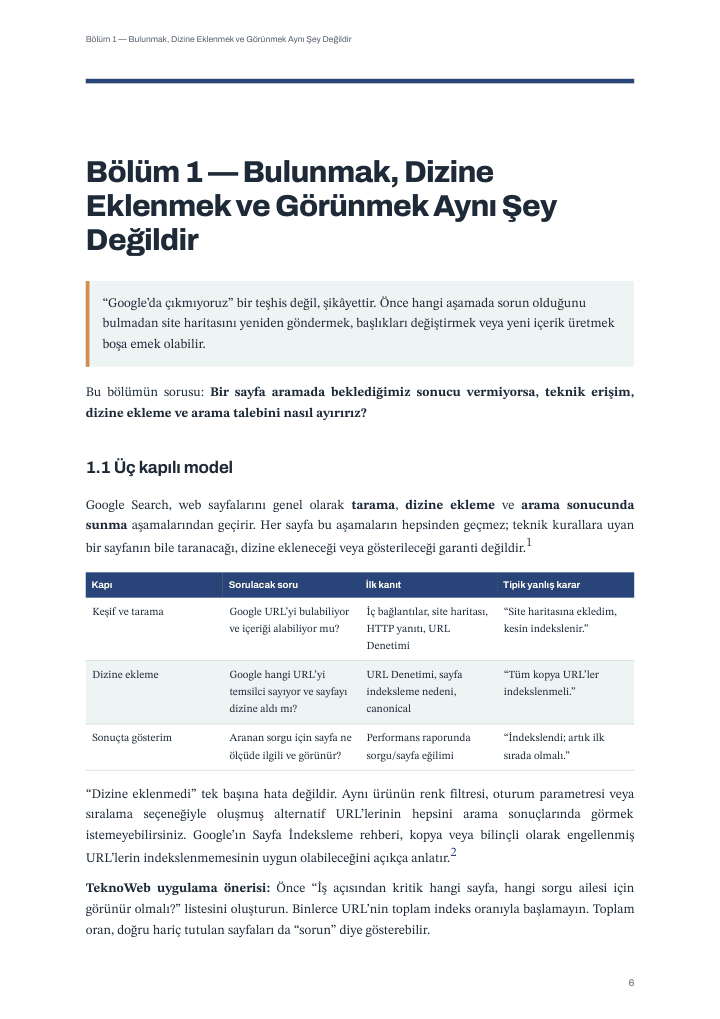
Chapter 1 opening and guiding question (Turkish edition) 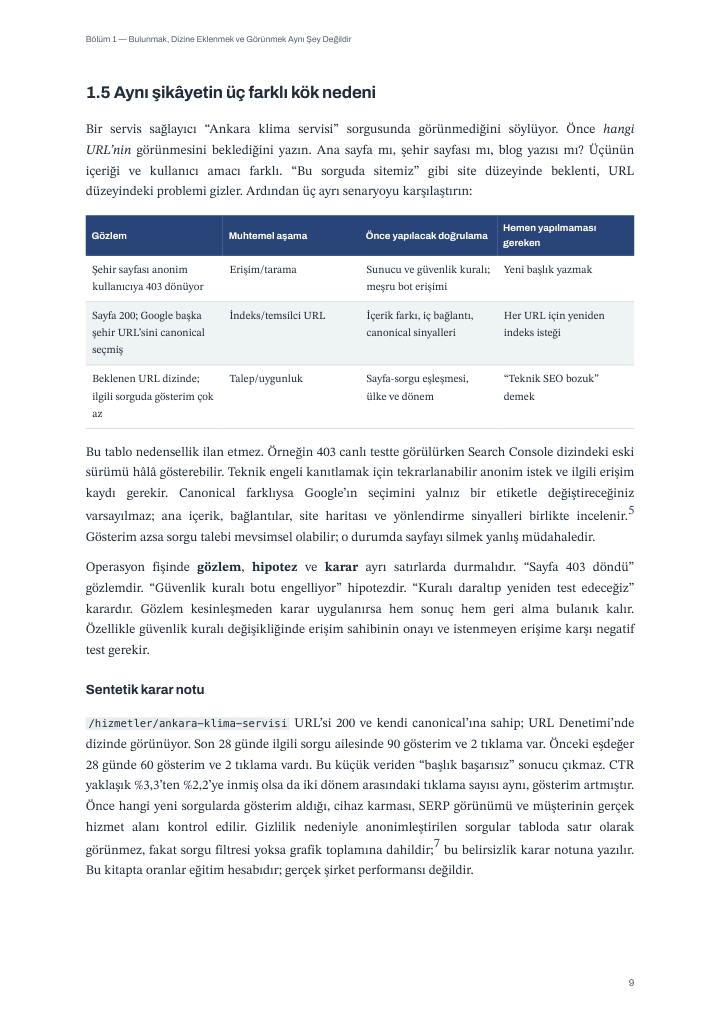
Three root causes of the same complaint 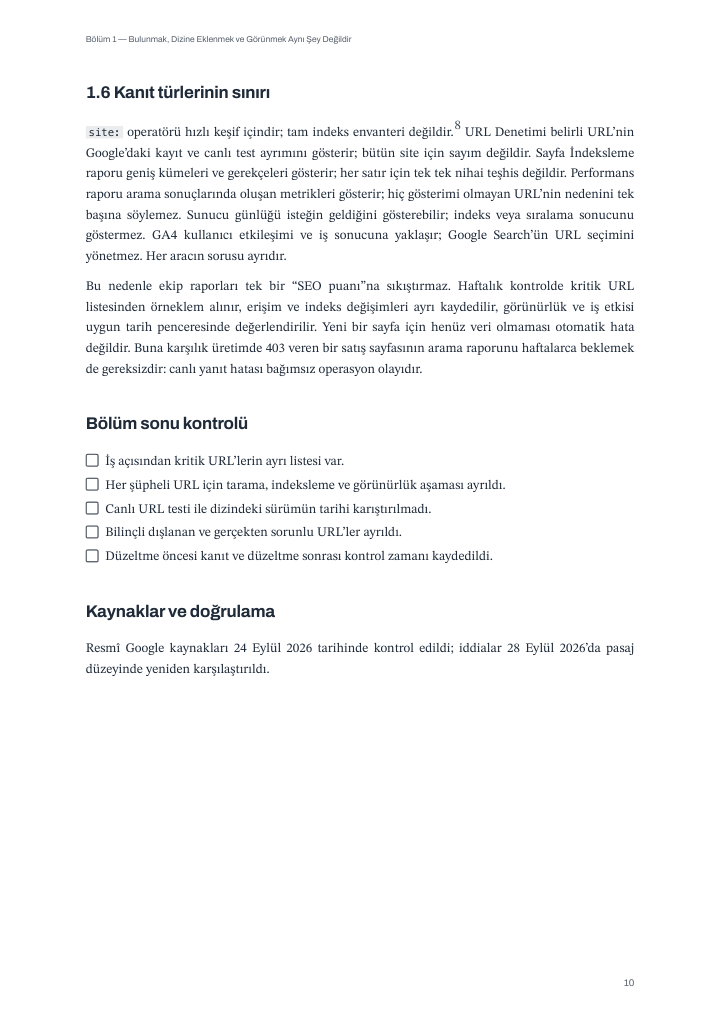
Chapter checklist
Who it is for
- Business owners connecting indicators to decisions
- Technical teams handling URL diagnostics, release tests and rollback
- Editors establishing source and version discipline
- Teams migrating websites
Who it is not for
- People seeking ranking guarantees or magical indexing
- People seeking paid-search guidance (covered in the Google Ads Search book)
Frequently asked questions
- Do I have to read the entire book in order?
- No. Beginners can read sequentially; practitioners follow symptoms. Owners can use 1, 9, 13–16 and C/G; technical teams 3–8, 11–12 and A/B/H–K; editors 8–10, 15 and E; migration teams 6 and D.
- Does the book guarantee rankings or traffic?
- No. It promises no rankings, traffic or sales. All company, product, traffic and migration examples are synthetic, not customer success claims.
- Can Search Console replace GA4 or sales records?
- No. CRM, sales records, GA4 and Search Console have separate definitions and limits. Search Console reveals parts of the chain, not the whole user experience or all revenue.
- When can I access the book after payment?
- Immediately after payment approval. Files appear in your Academy library and an access email is sent.
- What happens when a book is updated?
- The book is revised when Google interfaces or regulations change. New editions appear in your library at no extra cost.
- Can I get a refund?
- Digital delivery follows payment approval, with a withdrawal-right exception under distance-selling rules. Read the free sample chapter before purchase.
- Is an invoice issued?
- Yes. Enter personal or business billing details when ordering to receive an e-archive invoice.
Author

Author and trainer
Onur Dilmen
TeknoWeb founder. He has built business infrastructure in hosting and platforms for years, observing recurring advertising-account, measurement and search-visibility mistakes and their actual invoiced cost. The Academy series record those observations.
- Technical claims reference dated official Google sources
Its place in the series
TeknoWeb Akademi is an independent educational publisher, unaffiliated with and unendorsed by Google, Meta, Microsoft, TikTok or LinkedIn. Google and Google Ads are Google LLC trademarks; other marks belong to their owners.