

Google Ecosystem · Book 01
Reliable Measurement with GA4 and Tag Manager
A firing tag does not prove that a business outcome was measured correctly. From business outcomes to reliable data.
By the end of the book
- Trace reported numbers to business events using event dictionaries and data-layer contracts.
- Test the data layer, GTM version, consent behavior and GA4 report as one evidence chain.
- State where measurement observes, models or cannot establish an answer.
Book files are in Turkish.
Written by Onur Dilmen · Edition 1.0 · · 16 chapters, 16 appendices · 121 pages
TRY 790VAT included · one-time payment
Read the sample chapter (free)- Available in your panel after payment confirmation, with ongoing access.
- Print PDF, mobile PDF, Word and EPUB.
- New editions are free.
Digital content is delivered immediately; you separately confirm the withdrawal conditions at checkout.
Bu kitap hangi sorulara cevap veriyor?
Each chapter opens with a question and ends with its answer. 16 chapters ve 16 ek.
- 01
Which decisions must precede GA4 and Tag Manager so later reports are trustworthy?
Chapter 1 · Who owns measurement, and what does accuracy mean?
- 02
Who controls the data, and which GA4 property and GTM container should receive it?
Chapter 2 · Account, property, stream and access architecture
- 03
Which actions, names and fields make business events consistently interpretable?
Chapter 3 · From Business Questions to Event Dictionaries
- 04
How can analytics reliably receive and test business events while respecting privacy?
Chapter 4 · Data-Layer Contract
- 05
How do you turn a tag container into an understandable production system with clear destinations and purposes?
Chapter 5 · Web GTM Architecture and Release Governance
- 06
What evidence establishes correct event measurement?
Chapter 6 · Measurement Testing: From Preview to Production Evidence
- 07
How does a user preference reach Google tags and measurement, and where must engineers seek legal decisions?
Chapter 7 · Consent Signals, CMP and Legal Decision Boundaries
- 08
Which products and values belong to each purchase stage, and how do revenue and order records agree?
Chapter 8 · E-Commerce Measurement: From Cart to Refund
- 09
Why distinguish applications, qualified leads and converted opportunities?
Chapter 9 · Lead and B2B Measurement: From Form to CRM Outcome
- 10
Why can visiting a payment domain create a new user, session or payment-provider referral?
Chapter 10 · Sessions, Redirects and Cross-Domain Journeys
- 11
How do you separate staff, test and unwanted traffic without losing customer data?
Chapter 11 · Internal Traffic, Bots and Data Filters
- 12
How do you choose the metrics and scope that answer a business decision?
Chapter 12 · Connect Reports to Business Questions
- 13
Where do you start when the same sale appears differently in two Google reports?
Chapter 13 · Why Do GA4 and Google Ads Figures Differ?
- 14
Which decisions and permissions change when GA4 connects to another Google product?
Chapter 14 · Audiences and Google Product Links
- 15
Which data route, costs and privacy responsibilities follow when the GA4 interface is insufficient?
Chapter 15 · BigQuery and Data API: When Are They Needed?
- 16
Who detects future measurement failures, with which evidence and rollback plan?
Chapter 16 · Measurement Change and Incident Management
16 appendix headings
- AEvent Dictionary and Data Contract Template
- BMeasurement QA and Acceptance Matrix
- CSynthetic E-Commerce Data Contract
- DLead Reconciliation Worksheet
- ESource and Version Log
- FShort Glossary
- GE-Commerce Measurement Workshop: Trace an Order
- HB2B Lead Workshop: From Application to Qualified Outcome
- IConsent and Cross-Domain Workshop
- JWeekly Measurement Operations and Incident Response
- KFrom Scattered Tags to Managed GTM
- LMeasurement-Based Decision Case Cards
- MRelease Acceptance: Verify Measurement in Real Journeys
- NBigQuery Sales Reconciliation Workshop
- OBusiness Models: Subscriptions, Appointments and Marketplaces
- PServer-Side Tagging: When, How and With Which Evidence?
Inside the book
Pages from the sample chapter. Businesses and figures in the examples are synthetic.
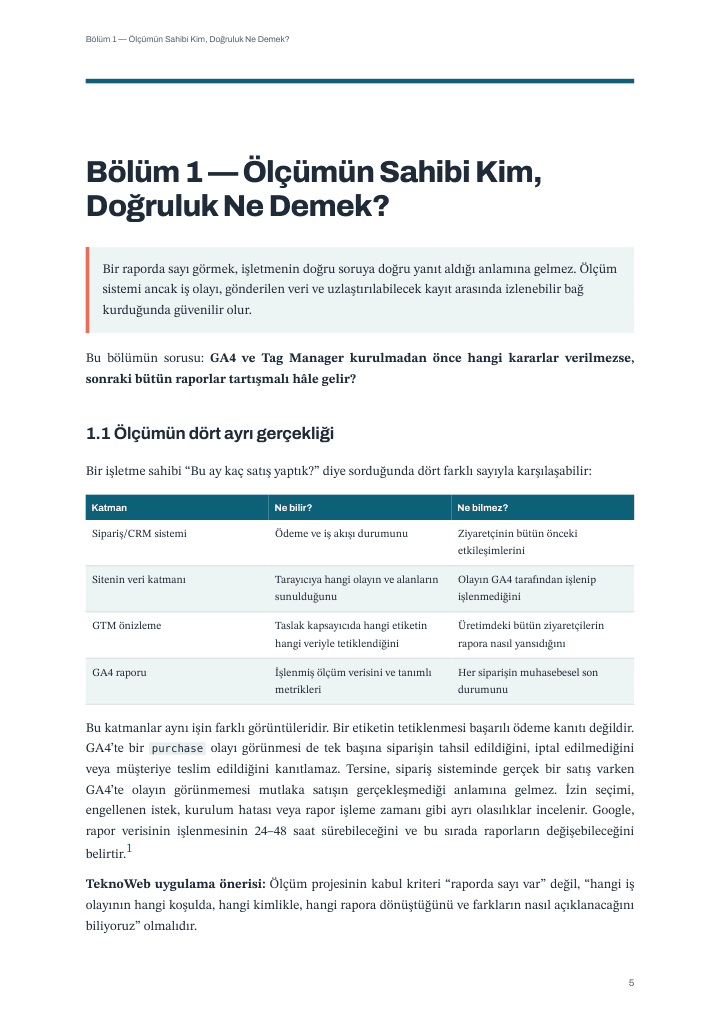
Chapter 1 opening and guiding question (Turkish edition) 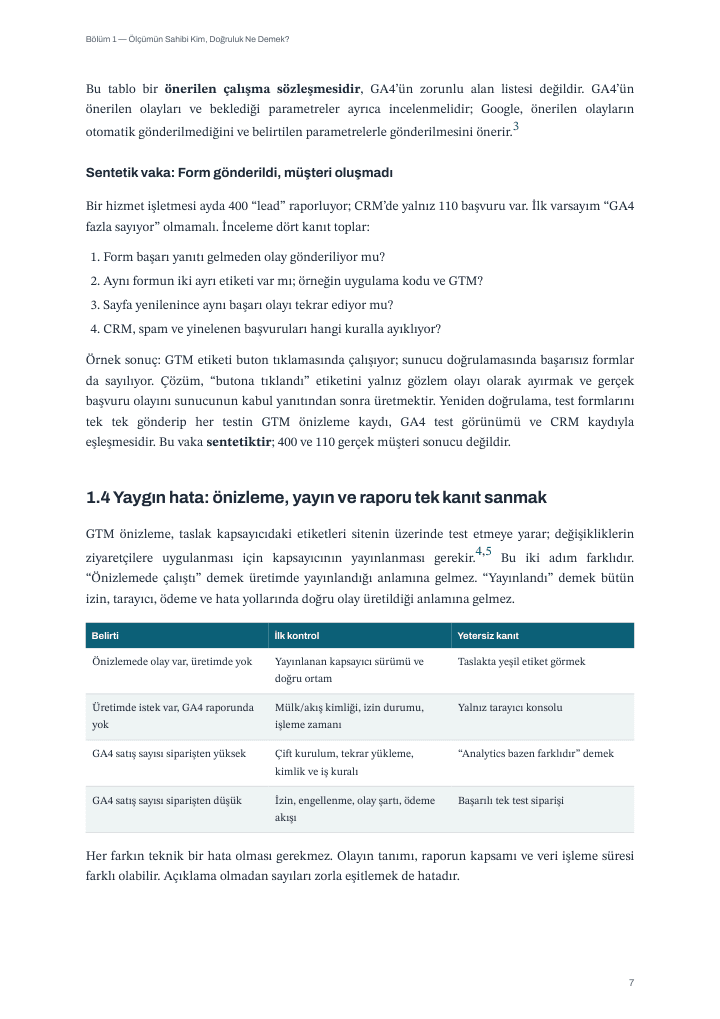
Synthetic case and evidence table 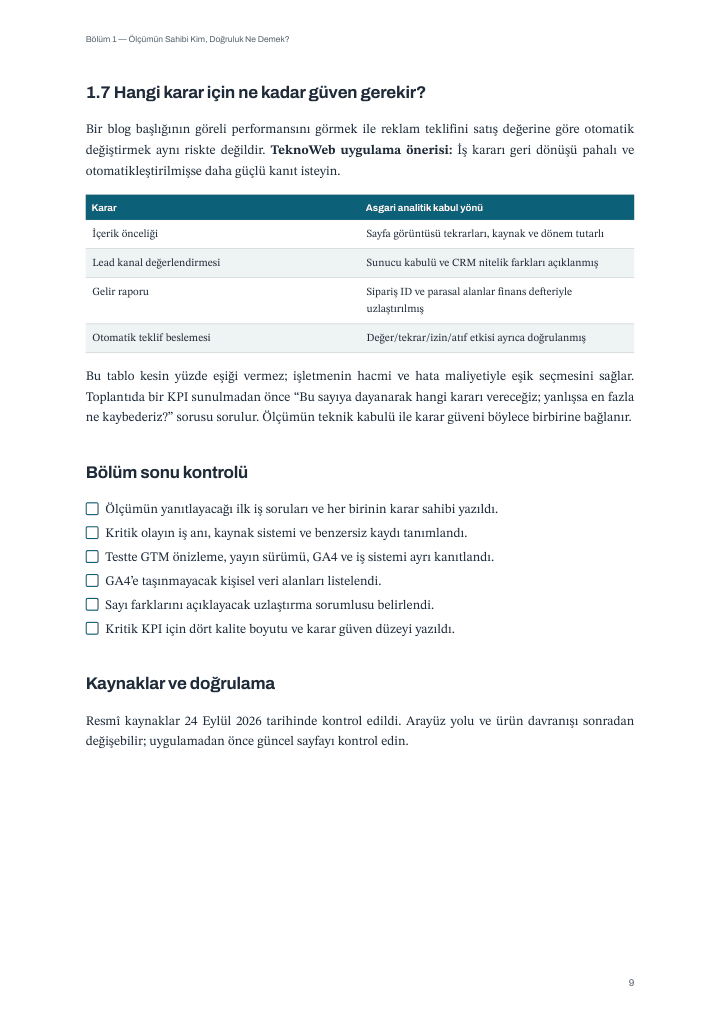
Chapter checklist
Who it is for
- Business owners making measurement-based decisions
- Technical teams implementing tags and data layers
- Teams measuring e-commerce and lead journeys
- Analysts reconciling GA4 with sales and CRM records
- Agencies and measurement specialists taking over existing setups
Who it is not for
- People selecting bidding conversions (covered in Google Ads Book 2)
- People expecting legal compliance certification
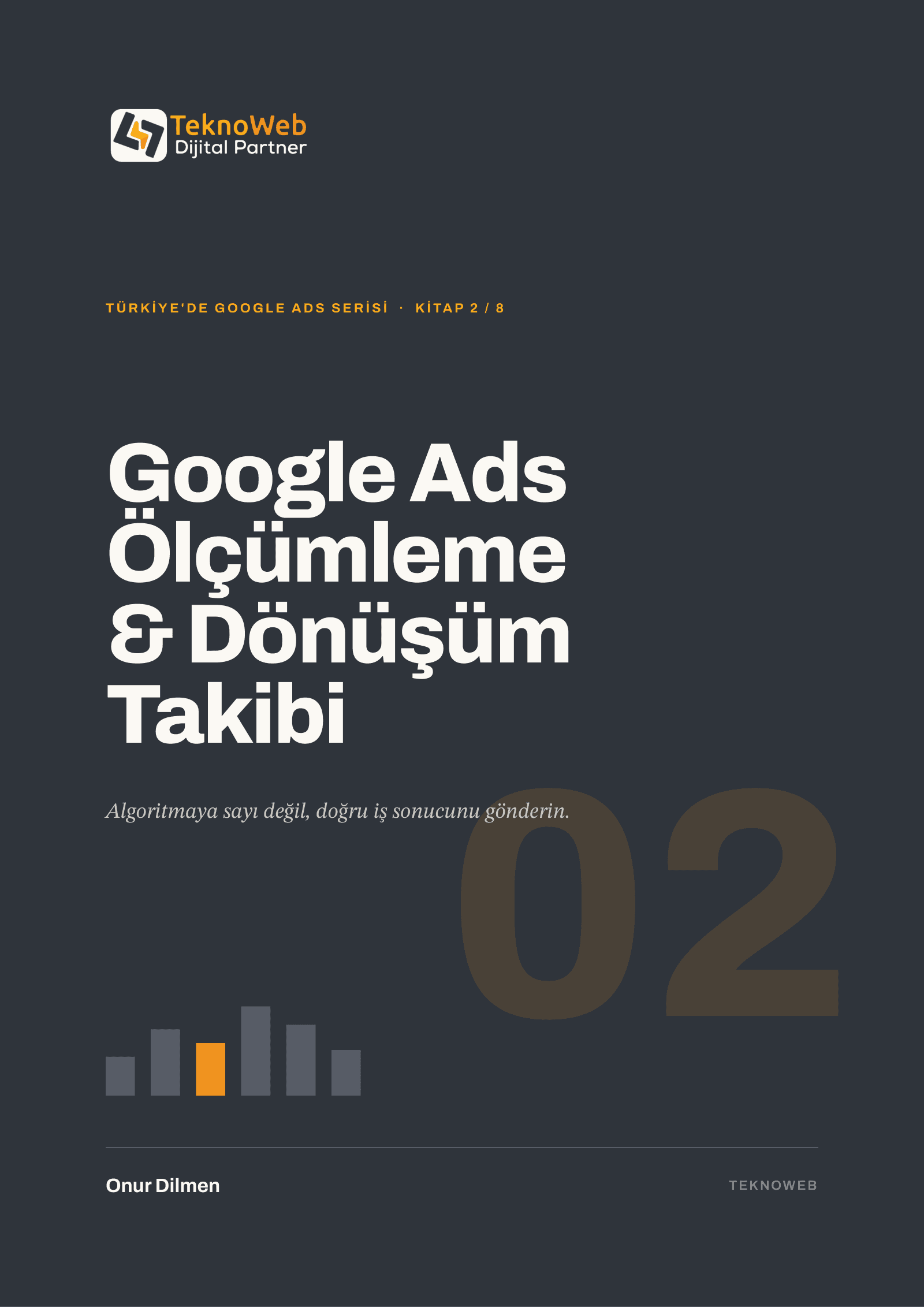 Related bookMeasurement and Conversion TrackingCovers bidding-conversion selection and Google Ads conversion measurement.
Frequently asked questions
- Do I have to read the entire book in order?
- No. Beginners can read sequentially; specialists can follow symptoms. Owners can start with chapters 1, 3, 12, 13 and appendix L; implementers with 4–11, analysts with 15 and N, release owners with 16 and M.
- Is the book enough for KVKK compliance?
- No. It explains consent's technical flow and when legal review is necessary, without issuing compliance certificates. Purpose, data, retention, sharing and preferences require joint review by the controller, legal adviser and technical owner.
- Does it also cover Google Ads conversion tracking?
- Chapter 13 explains differences between GA4 and Ads figures; chapter 14 covers product links. Selecting bidding conversions belongs to the Google Ads Measurement and Conversion Tracking book.
- When can I access the book after payment?
- Immediately after payment approval. Files appear in your Academy library and an access email is sent.
- What happens when a book is updated?
- The book is revised when Google interfaces or regulations change. New editions appear in your library at no extra cost.
- Can I get a refund?
- Digital delivery follows payment approval, with a withdrawal-right exception under distance-selling rules. Read the free sample chapter before purchase.
- Is an invoice issued?
- Yes. Enter personal or business billing details when ordering to receive an e-archive invoice.
Author

Author and trainer
Onur Dilmen
TeknoWeb founder. He has built business infrastructure in hosting and platforms for years, observing recurring advertising-account, measurement and search-visibility mistakes and their actual invoiced cost. The Academy series record those observations.
- Technical claims reference dated official Google sources
Its place in the series
TeknoWeb Akademi is an independent educational publisher, unaffiliated with and unendorsed by Google, Meta, Microsoft, TikTok or LinkedIn. Google and Google Ads are Google LLC trademarks; other marks belong to their owners.