

Google Ads in Türkiye series · Book 02
Google Ads: Measurement & Conversion Tracking
The most dangerous advertising-account mistake is not having no data. It is marking the wrong event as success and trusting that data. Send the algorithm the right business outcome, not just a number.
By the end of the book
- The conversion action represents an actual business outcome or a deliberately chosen intermediate signal.
- The same transaction is not counted twice; value and currency are transmitted correctly.
- Data flow between Google tag, Google Tag Manager, GA4 and Google Ads is documented.
- Consent signals match tag behaviour; hashed personal data is not mistaken for anonymous data.
- E-commerce revenue, lead quality, calls and offline sales can be reconciled with actual business records.
- Differences between Google Ads and GA4 can be explained through a structured diagnostic flow.
Book files are in Turkish.
Written by Onur Dilmen · Edition 1.0.2 · · 18 chapters, 6 appendices · 128 pages
TRY 990VAT included · one-time payment
Read the sample chapter (free)- Available in your panel after payment confirmation, with ongoing access.
- Print PDF, mobile PDF, Word and EPUB.
- New editions are free.
Digital content is delivered immediately; you separately confirm the withdrawal conditions at checkout.
What does each chapter cover?
Each chapter's subject, using its opening question or statement. 18 chapters ve 6 ek.
- 01
Which action should you send to Google Ads as success?
Chapter 1 · The Measurement Mindset
- 02
How do you establish a traceable chain between a business outcome, a web/app event and an advertising-platform conversion?
Chapter 2 · Measurement Plan and Conversion Dictionary
- 03
Conversion Actions and Goal Architecture
An account can have the correct tags while its campaign still bids toward the wrong goal.
- 04
Google Tag and GTM Architecture
Implementing a tag is more than pasting code on a screen.
- 05
GA4 Events, Key Events and Google Ads Conversions
Not every important-looking GA4 event is a Google Ads bidding signal.
- 06
Enhanced Conversions
Enhanced Conversions does not replace a broken base conversion setup.
- 07
Consent Mode and CMP
Consent Mode does not ask the user for consent.
- 08
KVKK and Data Governance
This chapter does not provide a legal opinion.
- 09
Attribution and Conversion Paths
Attribution does not conclusively identify the true cause of a sale.
- 10
E-Commerce Measurement
E-commerce measurement centres on the unique order record, not the success page.
- 11
Lead and B2B Measurement
A form submission creates an enquiry; qualified leads and sales create business outcomes.
- 12
Offline Conversions and Data Manager
Offline measurement is more than uploading a CSV.
- 13
Calls, Appointments and Local Businesses
Call duration is a proxy for intent; appointments and sales are business outcomes.
- 14
Value-Based Measurement
Conversion count answers how many; conversion value answers how important.
- 15
App and Cross-Platform Measurement
The web and app may represent the same brand, but identity, consent, SDK, store and attribution mechanisms differ.
- 16
Verifying the Setup
Tag fired is only an intermediate check.
- 17
Why Do the Numbers Differ?
A difference is not always an error; an unexplained difference is.
- 18
Lesser-Known Tools and Measurement Audit
A professional audit does not pretend to explain every number.
6 appendix headings
- AMeasurement Audit Checklist
- BMeasurement Plan Templates
- CTechnical Examples
- DDiagnostic Decision Trees
- EGlossary
- FBibliography
Inside the book
Pages from the sample chapter. Businesses and figures in the examples are synthetic.
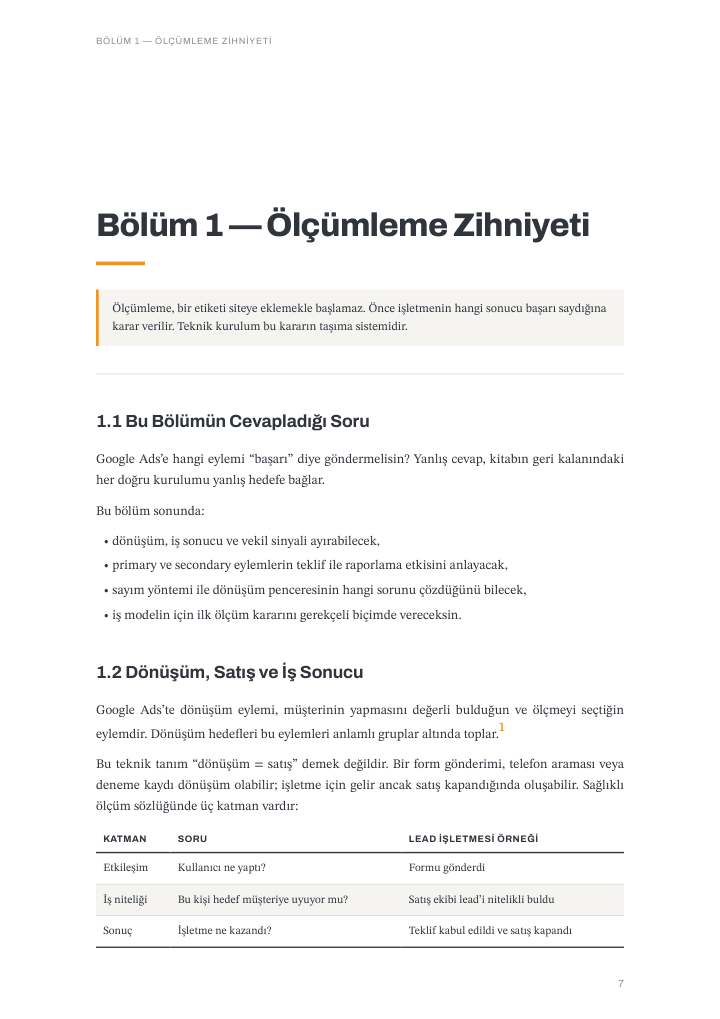
Chapter 1 opening and guiding question (Turkish edition) 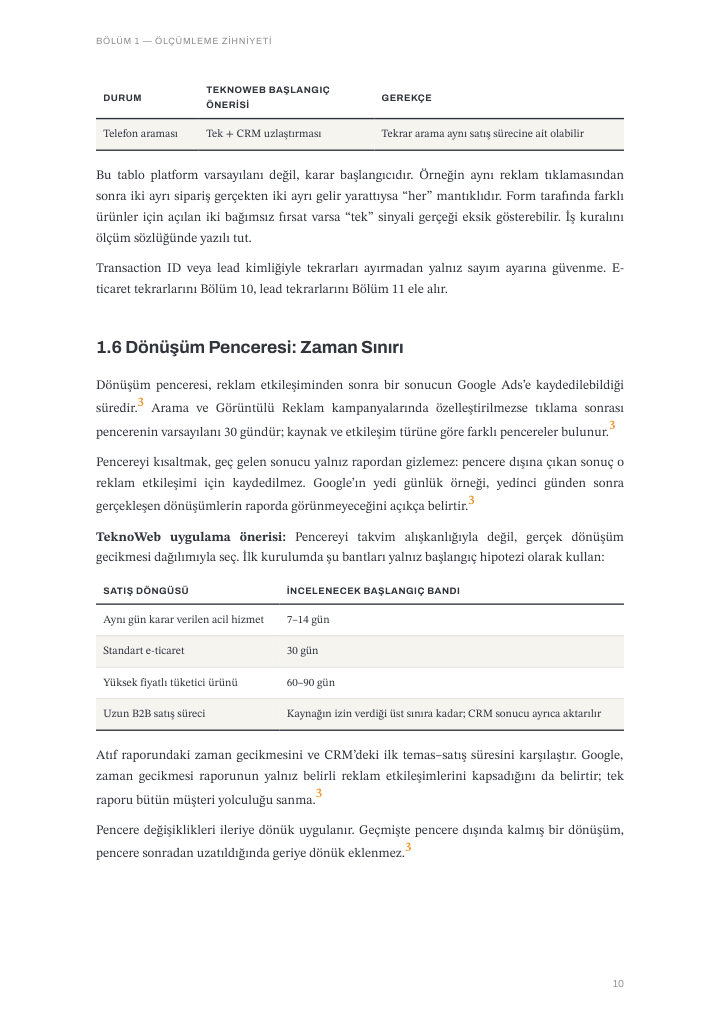
Counting and conversion-window tables (Turkish edition) 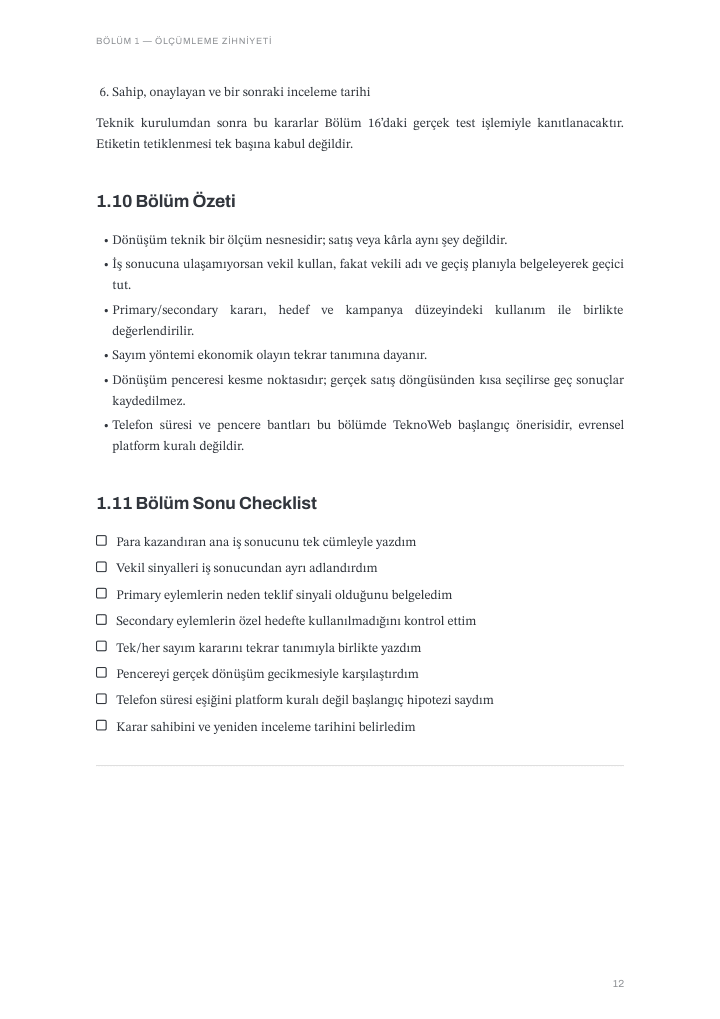
Chapter summary and final checklist (Turkish edition)
Who it is for
- Advertising specialists managing the account
- Business owners
- E-commerce teams
- CRM and sales operations
- Developers implementing tags
- Data governance staff
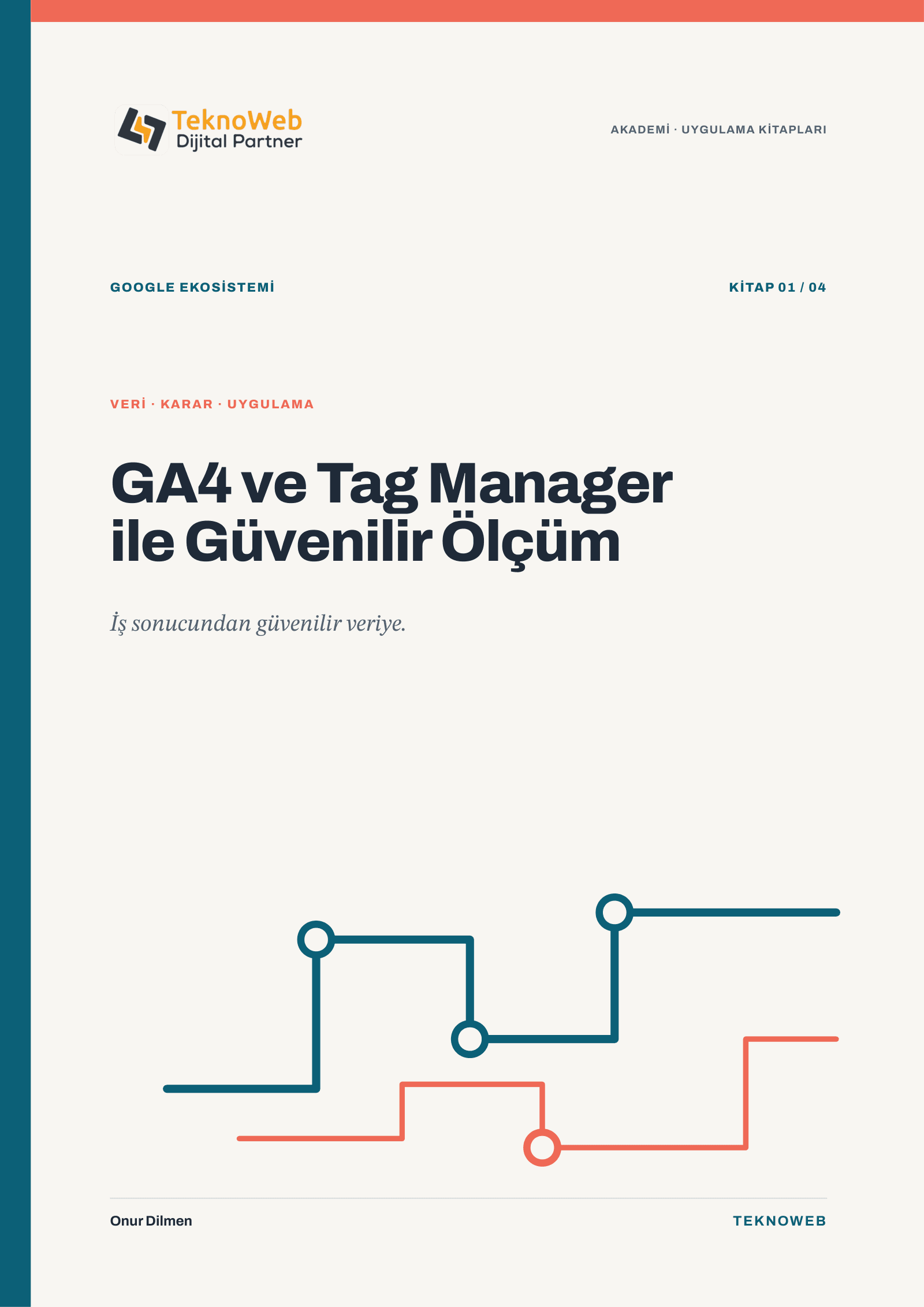 Related bookReliable Measurement with GA4 and Tag ManagerThe GA4 book distinguishes its scope: conversion selection for advertising bids belongs to Google Ads Book 2, while GA4/GTM data collection and analytics quality remain its focus.
Frequently asked questions
- Do I need to write code to understand the book?
- No. Understanding the main text does not require coding. Technical details appear in separate boxes where needed and in Appendix C.
- I have taken over an existing account; where should I start?
- Start with the evidence chain in Chapter 16 and the 90-minute audit in Chapter 18, then revisit relevant chapters based on the findings. For new setups, proceed in order.
- Is the book enough for KVKK compliance?
- No. The book is informational; legal topics rely on authoritative Turkish sources and are not legal opinions. Business-specific KVKK decisions require the data controller, legal adviser and technical lead together.
- When can I access the book after payment?
- Immediately after payment approval. Files appear in your Academy library and an access email is sent.
- What happens when a book is updated?
- The book is revised when Google interfaces or regulations change. New editions appear in your library at no extra cost.
- Can I get a refund?
- Digital delivery follows payment approval, with a withdrawal-right exception under distance-selling rules. Read the free sample chapter before purchase.
- Is an invoice issued?
- Yes. Enter personal or business billing details when ordering to receive an e-archive invoice.
Author

Author and trainer
Onur Dilmen
TeknoWeb founder. He has built business infrastructure in hosting and platforms for years, observing recurring advertising-account, measurement and search-visibility mistakes and their actual invoiced cost. The Academy series record those observations.
- Her teknik iddia Google dokümantasyonundan doğrulandı ve tarihiyle dipnotlandı
Its place in the series
TeknoWeb Akademi is an independent educational publisher, unaffiliated with and unendorsed by Google, Meta, Microsoft, TikTok or LinkedIn. Google and Google Ads are Google LLC trademarks; other marks belong to their owners.